
Kootenai County Arrest Records and Charges
Kootenai County arrest records can show that a person was taken into custody, the arresting agency, the arrest date, an offense description, a related case number, bond due, and whether the arrest was tied to a warrant or custody event. The sheriff's Current Inmate List is a custody report, not the final criminal court record. It can be useful right after an arrest because the court case may not yet show every filing.
Court charges after arrest begin when the prosecutor files or amends charges in the District Court case. The Kootenai County Prosecuting Attorney has jurisdiction over many actions, applications, and motions in District or Magistrate Court where the people, State, or County are a party or interested. Once charges are filed, iCourt and the District Court Records Department become the main channels for the formal charge record. Full disposition and sentencing belong in the Kootenai County criminal court records case file.
The assigned image from the Kootenai County Sheriff's command staff page connects arrest records to the sheriff side of the process.
Sheriff records help identify arrest context, while District Court records control the filed charge and case outcome.
Find Kootenai County Arrest Records
Use the sheriff's In-Custody Report for current jail custody and booking context. The linked Current Inmate List is a PDF report, so there is no fielded search form. Use browser or PDF find by name, then verify with the Kootenai County Jail at 208-446-1400 when custody status matters. For court charges after arrest, search iCourt by case number or defendant name and filter to Kootenai County.
- Check the sheriff's in-custody report for current jail or booking context.
- Use the name, related case number, offense description, or arresting agency from the custody report.
- Search iCourt Smart Search by defendant name or case number for the filed court case.
- Read each charge, amendment, status entry, disposition, and bond or financial entry separately.
- Request copies from District Court Records if the public case summary does not show the needed document.
For statewide custody after sentencing, the Idaho Department of Correction Resident/Client Search covers people under IDOC jurisdiction, including incarcerated, probation, or parole status. It does not replace the county case file.
Kootenai County Arrest Record vs Charge
The arrest record and the filed charge record answer different questions. An arrest record answers what law enforcement or jail staff recorded about custody. A court charge answers what accusation was formally filed with the court. One arrest can produce no filed charge, one charge, or several charges. A filed charge can later be amended, reduced, dismissed, or resolved by plea or trial.
| Point | Arrest Record | Court Charge Record |
|---|---|---|
| Main custodian | Sheriff, jail, or arresting agency. | District Court and prosecutor-filed case. |
| What it shows | Custody, arrest type, offense description, agency, bond, and booking context. | Formal charge, count, status, hearing history, disposition, and sentence if reached. |
| Best first source | Sheriff in-custody report or jail phone confirmation. | iCourt Smart Search and District Court Records. |
| Limit | Not proof of conviction. | May include charges that are later dismissed or amended. |
Kootenai County Charging Documents
After arrest, the formal charge record depends on a charging document. Idaho research for Kootenai County identifies complaint, information, and indictment as core criminal-case terms. The charging document is the bridge from arrest context to a court case. It names the offense accusation and starts or advances the criminal court file.
| Document | Who Files or Creates It | How It Functions |
|---|---|---|
| Complaint | Prosecutor or law enforcement process, depending on case type. | Starts many criminal matters and states the alleged offense. |
| Information | Prosecutor. | Common felony charging document after the required process. |
| Indictment | Grand jury process. | Formal accusation used in serious criminal matters when pursued that way. |
The assigned image from VINE reflects a victim notification channel tied to custody and court-event changes.
VINE can help track custody or court-event notifications, but it is not the official filed charge document.
Kootenai County Charge Status
Charge status can change as the prosecutor, defense, and court move through the case. Do not stop at the first charge line. Read the later disposition and sentence entries. A charge that appears early in the case may be reduced, amended, dismissed, or resolved in a way that differs from the arrest offense description.
| Status | What It Means |
|---|---|
| Pending | The accusation is active and no final court outcome is shown yet. |
| Amended | The filed charge changed after the original filing. |
| Reduced | The charge was lowered to a different level or offense by court action or agreement. |
| Dismissed | The charge was ended by the court and should not be treated as a conviction. |
| Disposition entered | The court has recorded an outcome, often followed by sentencing or compliance terms. |
Kootenai County Charges vs Convictions
A court charge is an accusation. A conviction is a final legal result. Kootenai County arrest records and jail offense fields are even earlier in the process. They should not be read as a conviction unless the court record later shows a guilty plea, verdict, or other convicting disposition and sentence.
| Point | Charge | Conviction |
|---|---|---|
| Timing | Appears after arrest when filed or amended. | Appears after plea, trial, or court finding. |
| Meaning | Formal accusation. | Final result against the defendant. |
| Can change | Yes, it can be amended, reduced, or dismissed. | Later relief may exist, but the conviction must be read from the final record. |
| Where to verify | iCourt and District Court Records. | Disposition and sentence entries in the court file. |
The assigned image from the IDOC Resident/Client Search shows a statewide post-sentencing custody channel.
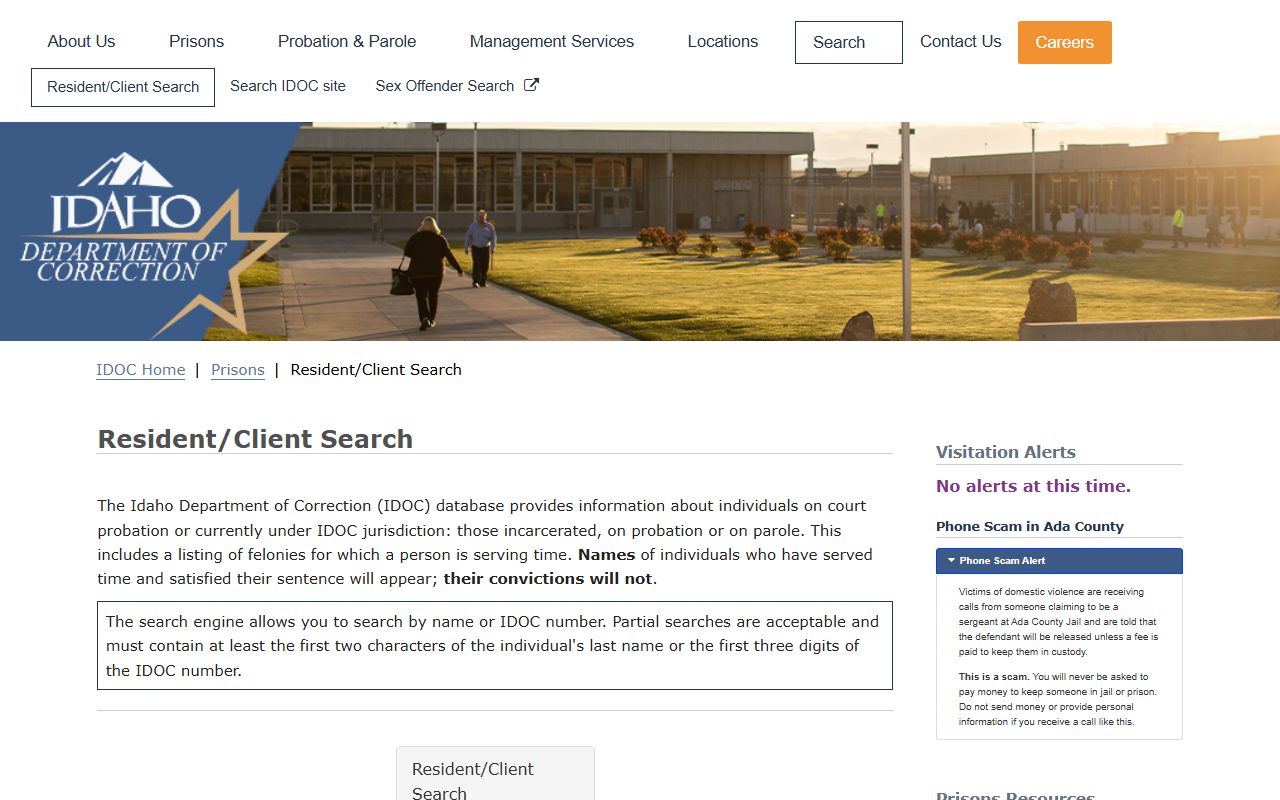
IDOC status can help after sentencing, but it does not replace charge-by-charge reading of the Kootenai County court file.
Warrants, Bonds, and Holds
The sheriff's jail research shows arrest types such as warrant arrest, custody arrest, probation violation, and hold for other agency. The active warrant page publishes felony and misdemeanor warrant reports and warns that all warrants must be verified through law enforcement before apprehension. Jail roster bond data can help explain release status, but bond terms and court orders should be checked against the court case.
Bond options in Kootenai County include bonding company, Point and Pay, inmate trust-account funds through JailATM or phone, and cash or property bond through the Clerk of the Court during business hours. The sheriff bond fee is $15 per case number for sheriff, Point and Pay, or JailATM bond channels, but not when bonding through court.
The assigned jail-property image comes from Kootenai County Jail inmate property.
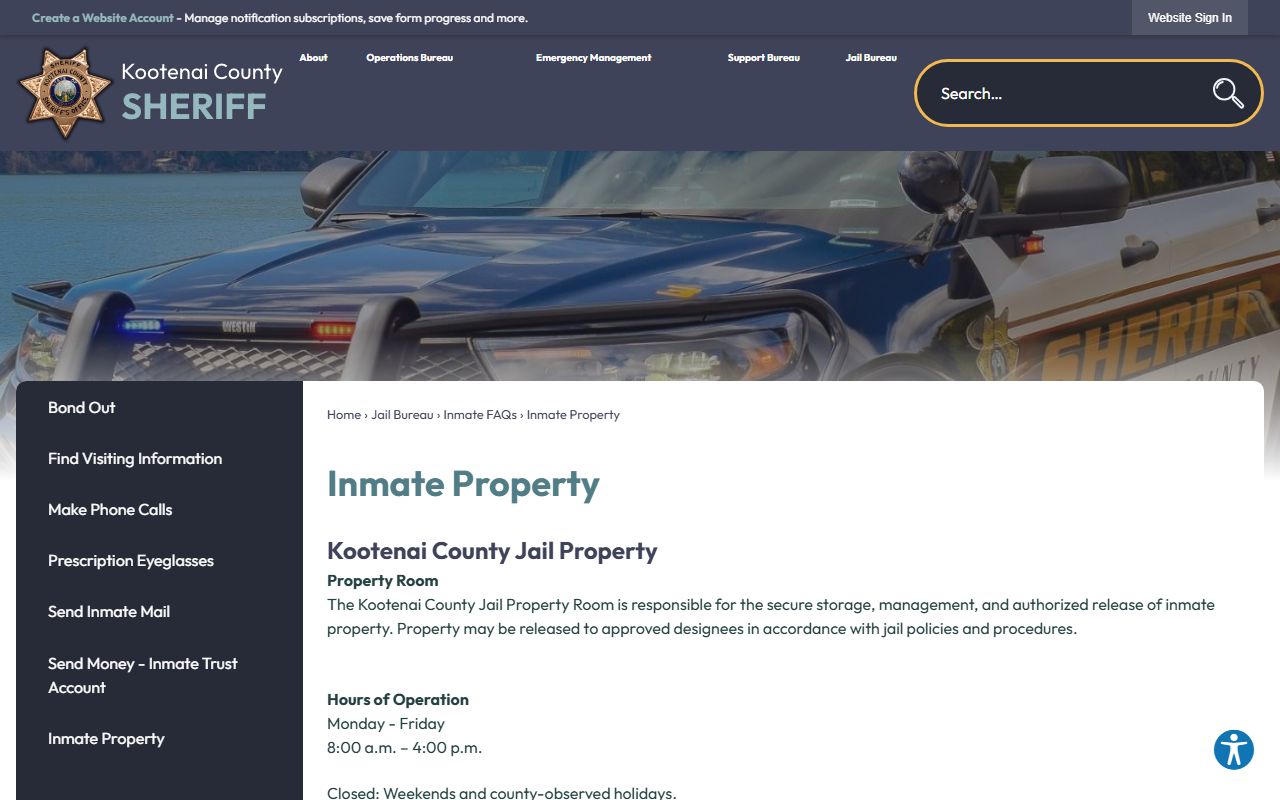
Property release and custody logistics are sheriff-side issues, separate from the filed charge and court disposition.
Statewide Charge Lookup Limits
Statewide sources can help with custody, supervision, or registry context, but they do not merge every arrest, charge, and conviction into one public court file. IDOC covers people under state correctional jurisdiction and updates daily, but data may lag or omit current county jail activity. The Idaho State Police sex offender registry is a separate registry source. VINE provides custody and court-event notifications where available.
The assigned image from the Idaho State Police sex offender registry belongs with this statewide limits section.
Registry status should be read from the official registry, while filed charges and convictions should be checked in the court record.
The assigned federal image from the Federal Bureau of Prisons inmate locator marks the federal custody path.
Federal custody data is separate from Kootenai County arrest records and Idaho District Court charge records.
Restricted Arrest Records and Charges
Access limits apply to both arrest records and court charges. Juvenile case material is not treated like ordinary adult records. Sealed cases and ICAR 32-exempt information do not appear in public iCourt. Adoption, mental health, protected domestic-violence information, personal identifiers, addresses, phone numbers, driver's-license numbers, and financial account numbers can be redacted or withheld.
Idaho adult relief is not one simple expungement rule. Idaho Code section 19-2604 can provide dismissal, discharge, or felony reduction in some cases, while Idaho Code section 20-525A supplies juvenile expungement authority and exclusions. For arrest records that did not result in charges, the court clerk may not be the right custodian. The relevant law enforcement or criminal-history agency process may be needed.
| Point | Sealed | Expunged or Relief |
|---|---|---|
| Public view | Hidden from ordinary public access in iCourt or the file. | Depends on the statute, record type, and court or agency order. |
| Adult route | Motion or sealing order where allowed. | Limited relief may exist under Idaho Code section 19-2604. |
| Juvenile route | Often restricted from the start. | Juvenile expungement follows Idaho Code section 20-525A. |
| Practical effect | Public search may omit the case or event. | Does not automatically erase every public, agency, or historical reference. |